


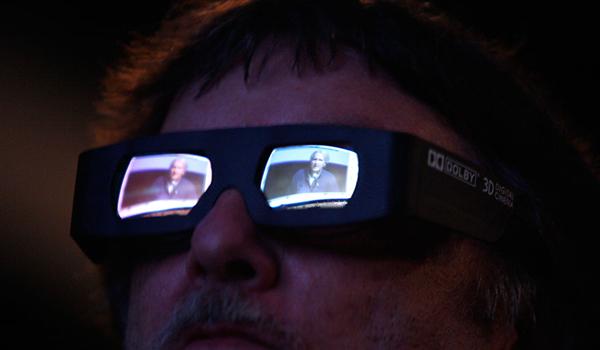
Roger Ebert in un lungo articolo per Newsweek, analizza i nove motivi che dovrebbero spingerci ad odiare il 3D.
Non perchè il 3D non sia un’opportunità per i cineasti, così come il digitale, l’imax, gli effetti speciali, ma perchè in questo inizio di 2010 sta diventando un’ossessione delle major, convinte, dagli incassi facili, dovuti al sovrapprezzo del biglietto, a convertire in stereoscopia praticamente ogni blockbuster.
Nell’ introduzione, Ebert riassume sinteticamente il suo punto di vista:
3-D is a waste of a perfectly good dimension. Hollywood’s current crazy stampede toward it is suicidal. It adds nothing essential to the moviegoing experience. For some, it is an annoying distraction. For others, it creates nausea and headaches. It is driven largely to sell expensive projection equipment and add a $5 to $7.50 surcharge on already expensive movie tickets. Its image is noticeably darker than standard 2-D. It is unsuitable for grown-up films of any seriousness. It limits the freedom of directors to make films as they choose. For moviegoers in the PG-13 and R ranges, it only rarely provides an experience worth paying a premium for.
Sembra quasi un’eresia di questi tempi di crisi…
I know it’s heresy to the biz side of show business. After all, 3-D has not only given Hollywood its biggest payday ($2.7 billion and counting for Avatar), but a slew of other hits. The year’s top three films—Alice in Wonderland, How to Train Your Dragon, and Clash of the Titans—were all projected in 3-D, and they’re only the beginning.
Ebert descrive poi analiticamente le sue obbiezioni, che vi invito a consultare online…
Alcune considerazioni meritano però di essere riportate anche qui. Come quella dell’elefante nella stanza…
Having shot Dial M for Murder in 3-D, Alfred Hitchcock was so displeased by the result that he released it in 2-D at its New York opening. The medium seems suited for children’s films, animation, and films such as James Cameron’s Avatar, which are largely made on computers. Cameron’s film is, of course, the elephant in the room: a splendid film, great-looking on a traditional IMAX screen, which is how I saw it, and the highest-grossing film in history. It’s used as the poster child for 3-D, but might it have done as well in 2-D (not taking the surcharge into account)? The second-highest all-time grosser is Cameron’s Titanic, which of course was in 2-D. Still, Avatar used 3-D very effectively. I loved it. Cameron is a technical genius who planned his film for 3-D from the ground up and spent $250 million getting it right. He is a master of cinematography and editing. Other directors are forced to use 3-D by marketing executives. The elephant in that room is the desire to add a surcharge.
Questo non esclude la possibilità che alcuni grandi registi lo usino al meglio, per creare qualcosa di unico:
I once said I might become reconciled to 3-D if a director like Martin Scorsese ever used the format. I thought I was safe. Then Scorsese announced that his 2011 film The Invention of Hugo Cabret, about an orphan and a robot, will be in 3-D. Well, Scorsese knows film, and he has a voluptuous love of its possibilities. I expect he will adapt 3-D to his needs. And my hero, Werner Herzog, is using 3-D to film prehistoric cave paintings in France, to better show off the concavities of the ancient caves. He told me that nothing will “approach” the audience, and his film will stay behind the plane of the screen. In other words, nothing will hurtle at the audience, and 3-D will allow us the illusion of being able to occupy the space with the paintings and look into them, experiencing them as a prehistoric artist standing in the cavern might have.
Ma soprattutto: il 3D è la risposta ad una minaccia. Quando Hollywood si sente sotto assedio, risponde sempre con una rivoluzione tecnica, per cercare di rendere unica l’esperienza cinematografica: è stato così con il sonoro, il colore, il widescreen, il Dolby e con il 3D, già sperimentato negli anni ’50.
Il problema però è che il gap si va accorciando immediatamente. Se oggi la minaccia sono gli splendidi ed enormi televisori in 16/9 e l’alta definizione dei blu ray, l’introduzione, sin da gennaio scorso, di tv capaci di riprodurre efficacemente il 3D e la loro diffusione sul mercato in questi giorni, sembra vanificare del tutto il piccolo vantaggio conquistato da Avatar.

 Stanze di Cinema